
General
State Quota in NEET: Eligibility Criteria and Application Process

Overview
The State Quota in NEET is an 85% reservation of government medical and dental college seats in each Indian state or Union Territory (UT) for residents of one particular state or UT. It is a quota mechanism to provide preference to local students for medical admission in their home state.
What Is State Quota In NEET?
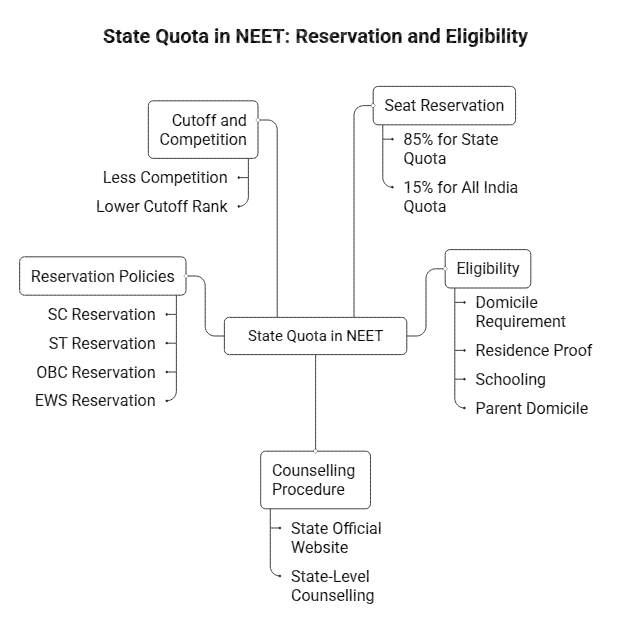
The State Quota means an 85% reservation of seats in government medical and dental colleges within each Indian state or Union Territory for resident students.
Seat Reservation: Up to 85% of the total seats in government medical colleges come under the State Quota. The rest, that is, 15%, are reserved under the All India Quota (AIQ) and are open to candidates from all over India.
Eligibility: Candidates satisfying the domicile requirement of the concerned state or UT are eligible for admission under the State Quota. The eligibility criteria differ from state to state, ranging from residence proof, schooling, or parent domicile.
Counselling Procedure: The counselling procedure for State Quota seats of a state or UT is different. The candidates will have to register on the official medical counselling website of the state and undergo rounds of counselling at the state level.
Reservation Policies: Reservation terms (e.g., SC, ST, OBC, EWS, etc.) are managed by state governments in the State Quota. State-to-state policies can differ greatly.
Cutoff and Competition: The cutoff rank for seats under the State Quota is less due to seats under All India Quota since competition is within the same state.
How Does the State Quota Work in NEET?
Here are some steps of how the state quota in NEET works:
Step 1: NEET Eligibility:
The aspirants have to pass in NEET UG with cut-off marks as defined by the state.
Step 2: Domicile Verification:
Original documents for domicile are submitted by the aspirants according to state norms and policies.
Step 3: Counselling Registration Under the State:
The selected candidates register for counselling on the official state portal.
Step 4: Merit List and Seat Allocation:
States compile a merit list based on NEET marks and allot seats as per rules and the candidate's priority.
Step 5: Admission:
Candidates are admitted to state government medical colleges, subject to verification of their documents and payment of the fee.
Why Is The State Quota Important?
Promotes Local Representation: Offers students from every state more access to medical education in their home state.
Aids Regional Talent: Maintains regional students who might wish to stay in their community after graduation.
Reduces Migration: Allows for little migration of students from home for education.
NEET State Quota vs. All India Quota: Quick Comparison:
Here you will understand the difference between State Quota and All India Quota:
Feature | State Quota (85%) | All India Quota (15%) |
|---|---|---|
Seat Share | 85% of govt. college seats | 15% of govt. college seats |
Eligibility | State domicile required | Open to all eligible NEET candidates |
Counselling Authority | State/UT counselling bodies | Medical Counselling Committee (MCC) |
Reservation Policy | State-specific | Central government policy |
Competition | Among state candidates | Nationwide competition |
Cutoff | Usually lower | Usually higher |
Read this article: AIQ vs State Quota Counselling
NEET State Quota Eligibility Criteria:
There are differences in eligibility criteria to obtain allocation by states to candidates for the state quota, but there are some common requirements:
Domicile Certificate – Proof of residence in the state (issued by a competent authority generally the District Magistrate).
Educational Qualification – Must have completed 10th and/ or 12th class from an institute in that state.
Duration of Residence – Some states may have minimum requirements for how long candidates must have lived in that state (e.g., 3 years or more).
NEET Pass – Candidates must pass NEET with a minimum score according to their category.
Eligibility For State Quota Depends On Domicile Rules:
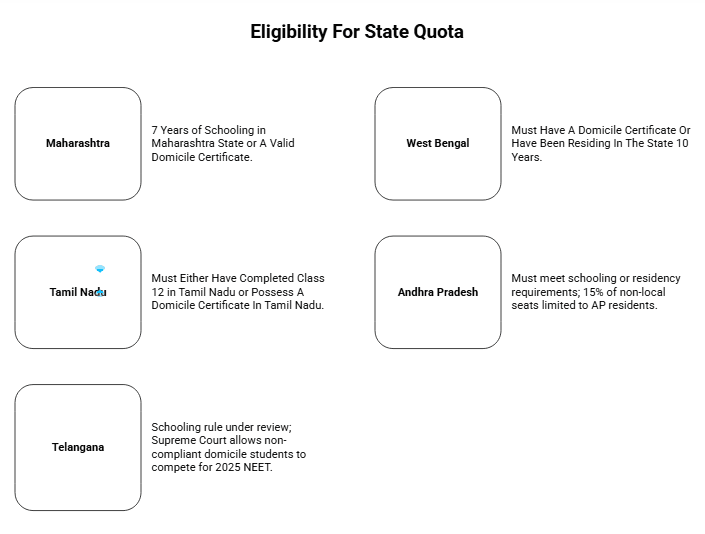
Maharashtra: Has a requirement of 7 Years of Schooling in Maharashtra State or A Valid Domicile Certificate.
West Bengal: Must Have A Domicile Certificate Or Have Been Residing In The State 10 Years.
Tamil Nadu: Must Either Have Completed Class 12 in Tamil Nadu or Possess A Domicile Certificate In Tamil Nadu.
Andhra Pradesh: To Be Considered a Local Resident Of AP, Must Either Have Completed Four Consecutive Years of Schooling in the Designated Local Area, Have Lived Here Continuously for Ten Years (by Parents or Yourself), or Have Attended School For Seven Of The Previous 10 Years Anywhere In AP. The Government Has Revised Their 2025 Guidelines And Limited 15% Of The Non-Local Seats To AP Residents.
Telangana: The Rule Comprehensive of 9–12 School Classes to Have Been Attended In TS Is Currently Under Review By The High Court & Supreme. However, The Supreme Court Has Granted A Temporary Order Allowing Domicile Students Who Do Not Meet This Rule To Compete For 2025 NEET State Quota.
State-Wise Domicile Criteria:
State | 2025 State-Quota Eligibility Criteria (NEET 2025) |
Maharashtra | 7 years of schooling in the state or a state-issued domicile certificate. |
West Bengal | Domicile certificate or 10 years’ continuous residency. |
Tamil Nadu | Class 12 in state or valid domicile certificate. |
Andhra Pradesh | 4 years schooling locally, or 10 years residency, or 7 years study anywhere in AP. Non-local 15% seats now limited to AP residents from 2025–26. |
Telangana | Must have studied/resided for 4 years, but HC has exempted this for domiciled students pending Supreme Court ruling. |
Karnataka | 7 years of state schooling or parent holding state domicile. |
How to Apply for State Quota in NEET?
State-wise quota applications require the following procedures:
Qualifying NEET UG 2025 (obtaining a qualifying score above your category last year).
Doing the registration step through the state counselling (go to Tamil Nadu State to register on the website of Dr. M.G.R. Medical University[as an example of the state]).
Submitting Required Documentation (including the following):
NEET scorecard
Marksheets Class 10 and 12
Domicile certificate (to prove that you live in the state)
Any category certificate (if applicable)
Proof of Residency (i.e. Aadhar Card/Voter ID)
Choose your choice during counselling for colleges and courses you prefer.
Seat allotments will be based upon your NEET Rank, your category and your desired preferences.
Reporting to the College to confirm your admission is necessary by presenting your original documentation and paying your tuition costs.
Each state conducts an individual counselling program through its own authority (typically, the State Department of Medical Education), so it is very important to register and provide documentation on time to avoid being shut out.
You can also contact Mycareerpathshala to apply for the state quota after your NEET result. We will guide you.
Reach us My career pathshala through:
Facebook: https://www.facebook.com/mycareerpathshala
Instagram: https://www.instagram.com/mycareerpathshala_official
YouTube: https://www.youtube.com/@mycareerpathshala
LinkedIn: https://www.linkedin.com/in/mycareer-pathshala/
Twitter: https://x.com/mycp_official
Whatsapp Community: https://whatsapp.com/channel/0029VbBfvQKEawdp13IOCW3i
Conclusion
State Quota in NEET is perhaps the single most significant aspect of medical admissions in India, reserving most government medical seats for local students and having each state's freedom to devise its own reservation and admission policy. Knowledge of these norms is crucial for test-takers applying for an MBBS seat in their home state.
FAQ’s
Q. What Does State Quota In NEET Mean?
State Quota in NEET is the reservation of 85% of seats in govt. medical colleges for candidates who are native to that specific state or UT.
Q. Who Is Eligible For NEET State Quota?
Candidates who meet the concerned state’s domicile, schooling, residency, and NEET eligibility rules can apply for State Quota seats.
Q. Is Domicile Mandatory For State Quota in NEET?
Not always. Domicile requirements vary by state, and some states also consider schooling or residency criteria.
Q. How many Seats Come Under State Quota in NEET?
Generally, up to 85% of government medical college seats are filled through the State Quota, while 15% are under the All India Quota.
Q. What Is The Difference Between State Quota and AIQ in NEET?
State Quota is conducted through state counselling and follows state-specific rules, while AIQ is conducted by MCC and is open to eligible candidates across India.